Fuel Adjusted Fares (FAF) Transparency Update
At Kiwi Coaches, we want to be open with our partners, schools, and families about what is happening in the fuel market and how it affects the cost of running school and group transport.
This page is designed to give clear, regular updates on Fuel Adjusted Fares, or FAF. Rather than making the issue vague or sudden, we want parents and partners to be able to see the pressures we are dealing with in real time, understand how those pressures affect operating costs, and follow any changes week by week. MBIE is currently saying fuel supply remains stable and within normal levels, but it is also warning that petrol and diesel prices are expected to continue to climb in the coming weeks, with weekly fuel price monitoring and twice-weekly stock updates now an important public reference point.
Why this page exists
Running buses has always involved more than simply putting diesel in the tank. Fuel is a major cost, but it sits alongside driver wages, road user charges, vehicle licensing, regular safety inspections, maintenance, tyres, cleaning, and day-to-day compliance. In New Zealand, heavy vehicles and vehicles operating under a transport service licence require a current Certificate of Fitness, diesel vehicles may require Road User Charges, and passenger service drivers must hold the correct licence class and a valid passenger endorsement. Operators are also expected to carry out pre-use checks and have systems for fault reporting and maintenance.
In normal times, those costs can be planned for with reasonable certainty. During a fuel shock, the largest change can happen quickly. That matters because our services still have to run every day. Routes still need to be covered, buses still need to be dispatched, and children, staff, and community groups still need to get where they are going safely and on time. MBIE’s current position is that the immediate issue is not physical supply disruption, but rising fuel prices flowing through from international conditions.
Why buses still make sense
Even with high fuel prices, buses remain one of the most efficient ways to move people at scale. NZTA research found mean car occupancy in New Zealand’s main urban areas was about 1.54 people per vehicle-kilometre, while Ministry of Transport work used an average passenger car occupancy of 1.56. A separate Ministry of Transport working paper says a well-used urban bus operation in New Zealand has a broad average occupancy of around 10 passenger-km per vehicle-km. In plain terms, one bus can move far more people in one trip than a string of individual cars, which is why school and group transport still makes sense economically and practically, even when diesel is under pressure.
That does not mean bus operating costs are unaffected. It means buses remain efficient shared transport, while still being directly exposed to diesel price increases.
What fuel increases mean in practice
When diesel rises sharply, the effect is immediate. A bus covering the same route, the same timetable, and the same kilometres can suddenly cost materially more to run than it did only a week or two earlier.
For operators like Kiwi Coaches, fuel increases do not arrive on their own. They sit on top of the fixed responsibilities of operating a compliant passenger service: keeping vehicles roadworthy, maintaining Certificates of Fitness, managing Road User Charges, carrying out inspections and repairs, and ensuring properly licensed drivers are on the road.
That is why this page is not simply about fuel prices in isolation. It is about the real running cost of keeping services moving safely and reliably during a period of unusually high volatility.
How Kiwi Coaches will approach FAF
Our aim is simple: transparency and fairness.
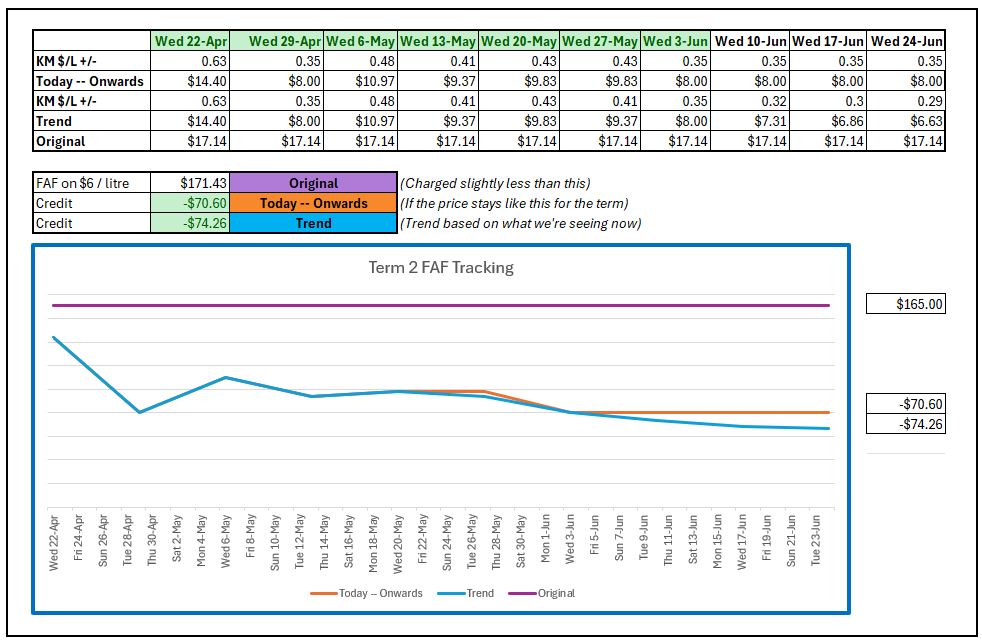
Where a Fuel Adjusted Fare is needed, it will be based on the real change in diesel cost against an agreed baseline, not on guesswork and not on broad, unexplained increases. We will use this page to show:
the current diesel market position,
the baseline point we are comparing against,
the estimated impact on running costs for our services,
whether FAF is being held, reduced, increased, or reviewed.
The purpose is not to over-recover costs. The purpose is to show clearly when extraordinary fuel movements are affecting the real cost of operating a service.
What we will update here
This page will be updated weekly, or more often if needed.
Each update will include:
the latest market position,
whether diesel prices have moved up or down,
the approximate impact on operating cost,
any change to FAF settings,
and a note on whether Kiwi Coaches is absorbing part of the increase, reviewing it, or passing through a portion of it.
We want families and partners to be able to check one page and understand the situation without confusion.
Current market note
As of MBIE’s latest published fuel security update on 15 April 2026, New Zealand fuel supply remained within normal levels, with total national diesel stock reported at 45.4 days’ cover as at 11:59pm on 12 April 2026. At the same time, MBIE has said higher prices are flowing through to fuel costs in New Zealand and that the price of petrol and diesel is expected to continue to climb in the coming weeks. MBIE’s weekly fuel monitoring data is currently updated weekly, and its fuel stock updates are being published every Monday and Wednesday afternoon.
Our commitment
Kiwi Coaches remains committed to keeping services running safely, professionally, and with as much stability as possible.
We understand that transport costs matter to families. We also know that sudden price movements can be frustrating. That is exactly why we are publishing this page. We would rather explain the numbers, show the trend, and be upfront about the pressure than leave parents guessing.
Where we can absorb increases, we will say so. Where a review is needed, we will say so. And where a Fuel Adjusted Fare becomes necessary, we will explain why, how it has been calculated, and when it will next be reviewed.
Thank you for your continued support, understanding, and trust.
Updated 8th May 2026